
Adding threads and mounting features is where a lot of designs go wrong, especially in sheet metal. The good news is that a few standard methods cover almost every case, and picking the right one is straightforward once you know the options.
Your options for holes
- Clearance hole: a plain hole a screw passes through, used with a nut or a threaded hole on the other side.
- Tapped hole: threads cut directly into the material so a screw threads in with no nut.
- Countersink or counterbore: a recess that lets a screw head sit flush or below the surface.
- Press-fit hardware: a nut, standoff, or stud pressed into the part to add strong threads, especially in thin sheet.
Tapped (threaded) holes
Tapping cuts threads directly into the part so you can drive a screw in without a separate nut. It works best when there is enough material depth for the threads to grip, which generally means machined parts or thicker plate. As a rule of thumb, you want a thread engagement of at least the screw diameter in aluminum, and more in softer materials. In thin sheet metal, tapped threads are weak and strip easily, so use press-fit hardware instead.
Ready to build? Call out your threads and get a price.
Get an instant quoteCountersinks and counterbores
When you want a screw head to sit flush or hidden, you recess the hole:
- Countersink: a cone-shaped recess, usually 82 or 90 degrees, that seats a flat-head screw flush with the surface.
- Counterbore: a flat-bottomed recess that seats a socket-head cap screw below the surface.
Match the recess to the screw type. A flat-head screw needs a countersink; a socket-head cap screw needs a counterbore. Tell us the screw and we cut the right recess.
Press-fit hardware (PEM)
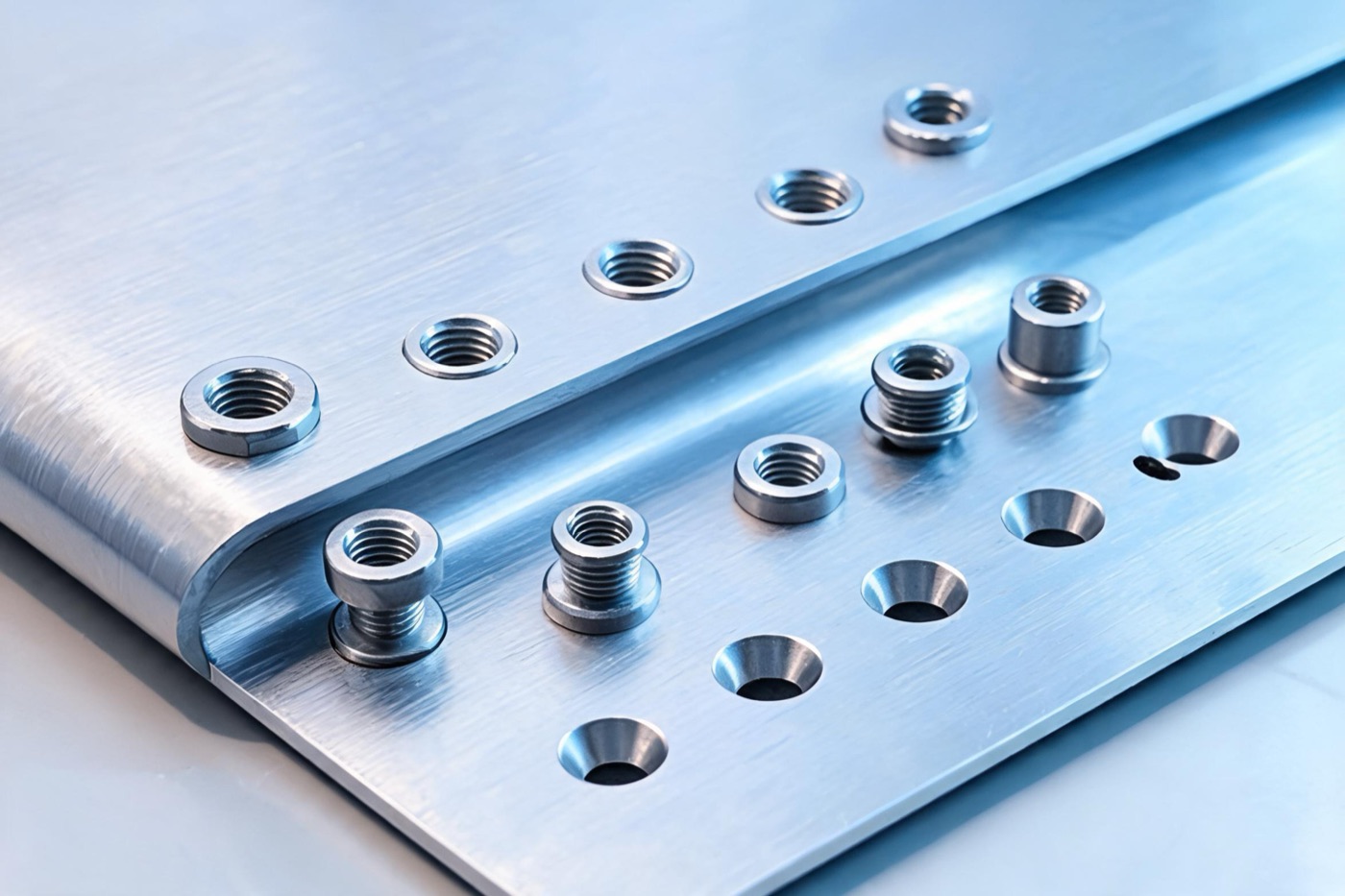
Self-clinching hardware, commonly known by the PEM brand, solves the thin-sheet problem. A self-clinching nut, standoff, or stud is pressed into a punched hole where it locks in permanently, giving you strong, reusable threads that are far stronger than tapping thin sheet. Common types:
- Self-clinching nutAdds a threaded hole to sheet metal.
- StandoffSpaces two panels or boards apart.
- StudA permanent threaded post to mount to.
Give us the hardware part number or the thread size and type, and we press it in before the part ships.
Threads in thin sheet metal
Rule of thumb: if the sheet is thinner than the screw diameter, do not tap it. Use a self-clinching nut or stud instead. Tapped threads in thin sheet strip out under normal use.
Design rules for holes
- Edge distance: keep holes and hardware at least 2 times the material thickness from any edge so the wall does not blow out.
- From a bend: keep holes at least 2.5 times the thickness plus the bend radius from a bend, or they distort when formed.
- Hardware clearance: press-fit hardware needs a minimum sheet thickness and space around it. Send the part number and we confirm fit.
- Call it out clearly: a quick PDF drawing that labels thread sizes, screw types, and hardware saves a round of questions.
Not sure which to use? Describe how your part gets fastened and a Darioo engineer will recommend tapping, hardware, or a recess, and confirm it fits your material before anything is made.